

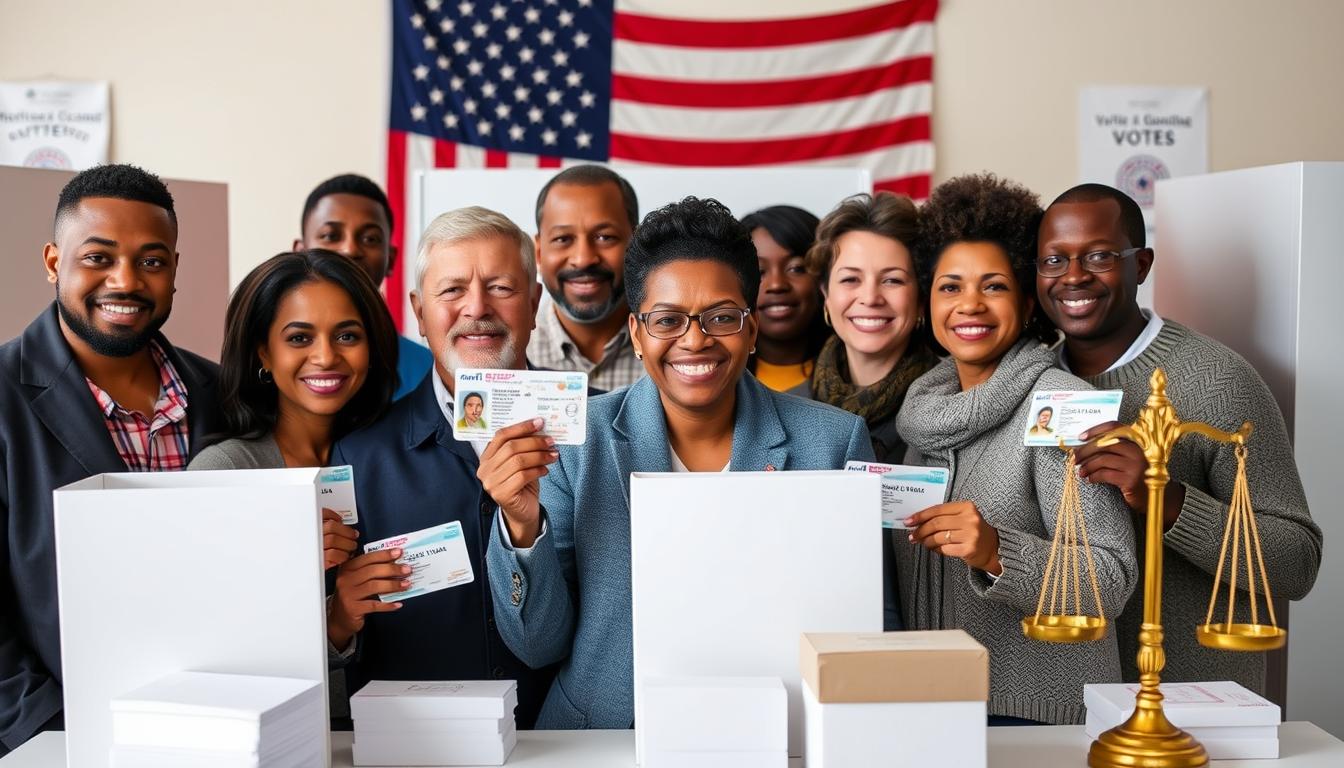
Did you know over 70% of states and territories offer flexible voting options? The voting process in the United States can seem complex. But this guide will help you understand how to make your voice heard.
Whether you want to vote in person, early, or by mail, we’ve got you covered. We’ll talk about different voting methods, voter registration, and finding your polling place. We’ll also cover voter ID laws, language assistance, and accessibility options.
So, if you’re ready to vote, keep reading. We’ll show you how to cast your ballot and join the democratic process.
Key Takeaways
- Over 70% of states and territories offer flexible voting options to cater to individual needs.
- More than 40 states allow early in-person voting before Election Day.
- Voting methods vary across the country, including paper ballots, electronic devices, and mail-in options.
- Voter ID requirements, language assistance, and accessibility accommodations differ by state and territory.
- Federal laws protect the right to vote, and the Department of Justice investigates voting rights complaints.
Voting Methods
In the United States, voters have many ways to cast their ballots. You can vote in person on Election Day or early. Some states even let you vote by mail or absentee. Each state has its own rules to fit different needs and preferences.
In-Person Voting
The most common way to vote is in person on Election Day. Voters go to a polling place to cast their ballots. This method lets voters directly participate in the electoral process.
Early Voting
Many states offer early voting. This lets voters cast their ballots before Election Day at certain locations. It’s great for those with tight schedules or who want to avoid Election Day crowds.
Vote-by-Mail and Absentee Voting
Some states allow vote-by-mail or absentee voting. Voters can request and submit their ballots by mail or at a drop box. This is helpful for those who can’t vote in person, like military personnel or people with disabilities.
“The U.S. Vote Foundation’s State Voting Methods and Options directory is an invaluable resource for voters, providing detailed information on the various voting options in each state and territory.”
Preparing to Vote
To vote in the United States, you must first register. You need to be a U.S. citizen, live in the area, and be at least 18 years old. You can register online, by mail, or in person. The deadline to register varies by state.
Voter Registration
Registration rules and deadlines change from state to state. For example, in Alabama, you must register in person 15 days before the election. In Alaska, it’s 30 days before. In California and Colorado, you can register on Election Day.
To register, you can use the internet, mail, or visit your local election office. You’ll need to show proof of who you are and where you live. Make sure to check your state’s rules and register early to be sure you can vote.
Finding Your Polling Place
After registering, you need to know where to vote. Polling places change, so it’s important to find yours. Many places offer online tools or hotlines to help. You can also call your election office for the information.
By understanding how to register and where to vote, you can make your voice heard. This is key to participating in democracy.
Voter Identification Requirements
In the United States, voter ID laws change a lot from state to state. Most states ask for a valid ID when voting in person. They also want ID info when voting by mail. But, what’s needed can vary a lot.
For instance, some states need a photo ID, like a driver’s license or passport. Others accept different IDs, like a birth certificate or Social Security card. Some states even let you vote without ID by swearing you are who you say you are.
- About 35% of U.S. states have strict photo ID rules for voting.
- Around 15% of states accept non-photo IDs.
- In many places, you don’t need to show your voter registration card when voting.
- Some states let you vote provisionally if there’s doubt about your eligibility. This can be checked later.
Voter ID laws also have special rules. For example, first-time voters might need to show certain IDs. If you change your name, you might need to tell election officials. These rules show how complex voter ID laws can be.
“Voter ID laws have a minimal impact on voter turnout or fraud, but may disproportionately affect certain demographic groups.”
It’s key to know the voter ID rules in your state for a smooth voting experience. You can usually get a free ID card from your state’s motor vehicle office. Even if you don’t drive, you can get one. There might also be groups that help with ID fees.
Language Assistance
In the United States, voters who don’t speak English well can ask for help when voting. They can get voting information and materials in their language. They also have bilingual poll workers to talk to.
The Voting Rights Act of 1965 and its updates protect language minority groups. They make sure voting materials and places are accessible in many languages. Over 330 places in the country must offer language help under the VRA.
For those who speak little English, translated voter guides and forms are very helpful. They help voters understand the voting process and make good choices. The Election Assistance Commission provides many resources, like voter registration forms in 21 languages and a Voting 101 Flyer in 20 languages.
Having bilingual poll workers is key for language assistance at the polls. The U.S. Department of Justice checks to make sure there are enough bilingual officials. This helps voters in other languages get the help they need.
“Engaging with voters in their native languages can be a powerful way for candidates to connect with diverse communities and expand their support.”
Language assistance is essential for fair and inclusive U.S. elections. We need to keep pushing for these rights. This way, all eligible citizens, no matter their language, can vote equally.
Accessibility Accommodations
Voting is a key part of democracy. It’s important that everyone, including those with disabilities, can vote easily. The United States has laws to make sure voting is accessible for all.
Voting with a Disability
The Americans with Disabilities Act (ADA), the Help America Vote Act (HAVA), and the Voting Rights Act (VRA) help. They make sure voting materials, equipment, and places are accessible. Most states also offer online voter registration, which is helpful for those with mobility issues.
- Accessible voting options include large-print ballots, audio instructions, and wheelchair-friendly polling stations.
- Voters can request absentee or mail-in ballots if their polling place is not accessible.
- Election officials are required to provide reasonable accommodations to ensure voting with disability is accessible for all.
Even with progress, people with disabilities sometimes face voting barriers. We keep working to make voting easier, educate voters, and enforce laws. This helps empower people with disabilities to vote.
“Voting is the foundation of our democracy, and everyone deserves an equal opportunity to participate, regardless of their disability.”
We can make voting more inclusive by pushing for accessible solutions and reporting any voting issues. This way, everyone can fully participate in our democracy.
Protecting Your Right to Vote
The United States government takes voting rights seriously. Federal laws protect against voting discrimination. These laws stop denying or restricting voting rights based on race, color, or language minority group membership. They also ensure people with disabilities have full voting access.
Voter registration is protected under federal law. The National Voter Registration Act requires states to offer many ways to register. States must let eligible people vote in federal elections if their application is postmarked by the deadline.
For military and overseas voters, the Uniformed and Overseas Citizens Absentee Voting Act helps. It lets them use the Federal Post Card Application to register and request an absentee ballot for federal elections.
The Civil Rights Division of the Department of Justice enforces these laws. This includes the Voting Rights Act, the Uniformed and Overseas Citizens Absentee Voting Act, and others.
Voters can find many resources and guides in different languages. These help learn about voting rights and how to report issues. Issues include being questioned about voting rights, not getting voting materials in required languages, or not getting needed accessibility.
“The right to vote is the foundation of our democracy. The Department of Justice is committed to protecting this fundamental right for all eligible voters.”
| Federal Law | Key Provisions |
|---|---|
| Voting Rights Act | Prohibits discrimination in voting based on race or color, and requires certain jurisdictions to provide language assistance to voters with limited English proficiency. |
| Uniformed and Overseas Citizens Absentee Voting Act | Protects the voting rights of U.S. citizens in the military or residing overseas, allowing them to use the Federal Post Card Application to register and request an absentee ballot. |
| National Voter Registration Act | Requires most states to offer various means for voter registration, and ensures eligible individuals can vote in a federal election if their registration application is postmarked by the deadline. |
| Help America Vote Act | Sets standards for voting systems and procedures, and provides funding to states to improve the administration of elections. |
| Civil Rights Acts | Prohibit discrimination in voting based on race, color, or membership in a language minority group. |
Become a Poll Worker
Voting is a key right in the United States. Poll workers are vital to keeping elections fair. They set up voting sites, welcome voters, check registrations, and explain how to vote.
The Election Assistance Commission (EAC) created National Poll Worker Recruitment Day to fix the poll worker shortage. The Help America Vote initiative encourages more people to join as poll workers.
The job of a poll worker varies by location. But, they are key to a smooth election. The 2022 Election Administration and Voting Survey (EAVS) shows 54.1% of places struggle to find poll workers.
Want to be a poll worker? The EAC offers many resources. They have a Poll Worker Preparedness Checklist and toolkits for training poll workers.
“Poll workers are the face of the election office during the voting process. Their dedication and commitment to ensuring every voter has a positive experience at the polls is invaluable.”
Being a poll worker is a big deal. It helps keep democracy strong and makes a real difference. Sign up today to Help America Vote.
How to Vote in the US
Figuring out how to vote in the United States can seem hard. But with the right info, you can vote with confidence. This guide will cover voting methods, why registering is key, and what you need to vote.
The US has many ways to vote, like in-person, early, or by mail. Make sure to register early, as deadlines change by state. After registering, find your polling place, which might have changed.
Every state has its own voter ID rules. Knowing what ID you need is important. Also, help is available for voters with disabilities or who need extra support.
It’s vital to protect your right to vote. If you face any problems, contact election officials or non-partisan groups for help.
Understanding how to vote in the us helps your voice be heard. Every vote matters. So, be informed, ready, and make your vote count!
“The right to vote is the cornerstone of our democracy. It’s our most fundamental right as citizens, and we must protect it fiercely.” – Michelle Obama
Special Circumstances
Some groups face special challenges when voting. This section looks at the voting issues for college students, homeless people, and those with criminal records.
College Students
College students can vote in their hometown or college town. This lets them vote in places they care about. But, they need to know the voting rules in each place to make sure their vote counts.
Homeless Voters
Homeless people have extra voting hurdles. Many places let them use shelters or parks as their address for voting. Some areas also offer mobile voting or drop-off spots. Homeless voters should check their local voting rules.
Convicted Felons
Voting rights for those with criminal records vary a lot. Some states let them vote while in prison, others after they’re out. The rules can depend on the crime, fines, or a pardon. Felons should look up their state’s laws to see if they can vote.
| Voting Rights for Convicted Felons | States |
|---|---|
| Voting rights retained while in prison | Maine, Vermont, and the District of Columbia |
| Voting rights automatically restored upon release from prison | California, Colorado, Connecticut, Hawaii, Illinois, Indiana, Maryland, Massachusetts, Michigan, Montana, New Hampshire, New Jersey, New York, Nevada, North Dakota, Ohio, Oregon, Pennsylvania, Rhode Island, Utah, and Virginia |
| Voting rights automatically restored upon completion of sentence, including prison, parole, and probation | Georgia, Idaho, Iowa, Kansas, Louisiana, Minnesota, Missouri, Nebraska, New Mexico, North Carolina, Oklahoma, South Carolina, South Dakota, Texas, Washington, West Virginia, and Wisconsin |
| Voting rights restoration can depend on various factors | Alabama, Alaska, Arkansas, Arizona, Florida, Delaware, Kentucky, Mississippi, Tennessee, and Wyoming |
Knowing the voting challenges for college students, homeless voters, and convicted felons helps officials and lawmakers. They can make sure everyone can vote, no matter their situation.
Resources for Specific Groups
The article offers helpful resources for certain groups, like military personnel and U.S. citizens abroad. These groups face special challenges when voting. The article points out reliable sources to help them vote.
Military and Overseas Voters
The Federal Voting Assistance Program (FVAP) is key for military voters and overseas voters. It’s run by the U.S. Department of Defense. The FVAP gives detailed info on how to register, request absentee ballots, and make sure their votes count.
The FVAP website (www.fvap.gov) has clear steps and state-specific advice. It also helps with filling out forms and sending ballots on time.
| Key Voting Resources for Military and Overseas Voters |
|---|
|
By using these resources, military voters and overseas voters can make sure their voices are heard. This is true even if they’re far away or in the military.

Conclusion
Participating in American elections is a key right and duty for all citizens. By learning about voting methods and preparation, voters can make sure their voices are heard. The fight for voting rights in the US has been long and hard, with big steps forward in 1965 and later.
But the battle for fair elections goes on. Many states have made voting harder for some, like racial minorities and the poor. Laws like voter ID and purging voter rolls hurt these groups, risking their right to vote.
Despite these hurdles, it’s vital for all eligible voters in the US to take part in democracy. By registering and voting, citizens help shape their communities and the country’s future. Together, we can protect and strengthen the right to vote, making sure elections truly reflect the people’s will.


Leave a Reply